My daughter is very creative. She is frequently in the kitchen creating masterpieces with art materials or kitchen foods. So when she requested a “scientist party” for her friend birthday party this year, I wasn’t surprised. This party was so much fun to plan and to do!! The party itself was very interactive. The trick is to have a plan and to keep the kids moving from one activity to the next with little downtime. (PS I don’t have a ton of pictures because there wasn’t any time to take any. I didn’t even have time to take any beforehand of the set-up. I’ll try to do the activities with my own kids again this summer and snap pictures then.) And please note, I’m a very simple mom. I don’t decorate. I’m frugal. I make it fun, but don’t go overboard!
Beforehand: To plan, I pretty much went through my teaching files and scoured the internet and looked up science experiments for kids. We then made a long list of experiments my daughter might want to do. When we got down to finalizing the party, I had her choose the experiments she wanted to do the most and we did most of those. We also selected some we could let the kids take-home.
Invitations: I found some cute science clipart online (see below), uploaded it into Word, added words, and printed it off on cardstock. I don’t have a picture of it, but here are the pictures of the clipart my daughter and I chose. I also mentioned in the invite to wear clothes that could get dirty.

Set-up: As mentioned previously, planning is crucial for this type of party. I went through every experiment thoroughly the night before, and laid everything for each experiment in groups on my table. I’m a little OCD so I actually laid them all out in the order we would be doing them. I also had my whole outline with experiment procedures/recipes nearby that I referred to often during the party. We did this party outside. I covered the tables with a cheap plastic tablecloth and put down a ground cover. We set up “stations” for each kid (we made a spot for each child coming). I didn’t assign their spots; we let them choose when they arrived. But we put out as many materials as we could at each spot. I also had little take-home trays prepared labeled with their names that they could put their things in as we finished them to take home (more on that later). Be sure to have lots of paper towels on hand and a large garbage can nearby.
Party: For this part, I’m just going to list the time-frame, use lots of links/recipes and possibly throw in a couple of pictures, and share any hints. This party should have lasted at least 2 hours. We were fighting for time so we limited it to an hour and 1/2, which means I had to cut some activities. And I have fast transitions… I would highly recommend a second set of hands. It would have been nice to have had a third adult helping, as well.
10:00-10:10 Opening (I always have an opening activity to keep the kids entertained while we wait for the others to arrive)
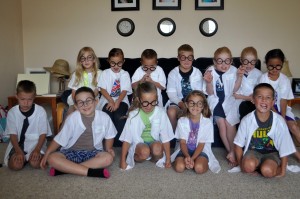
The mad scientists!
Get dressed in science gear (lab coats, glasses, and notebooks): We decided to have the kids dress as scientists to add to the ambiance (it also protected their normal clothes a bit). The first thing they did when they arrived was put on their scientist clothes. Because these were 6- and 7-year-olds for the most part, I bought cheap large and extra-large boy’s crew neck t-shirts to use as their lab coats. I cut them straight up the middle. I found some Harry Potter type glasses at my party store to use as their nerdy science glasses. And I made a label for each kid: “Dr. (name).” I also provided a cheap notebook and pen for writing down their observations. They thought it was the greatest! So simple. So cheap.
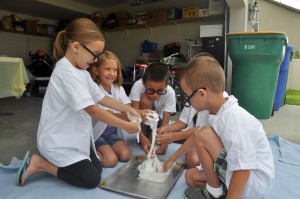
The only picture I got! Playing with polka-dot slime.
Play with polka dot slime: Slime with pom-poms mixed in.
M&M Experiment: Fill a small cup with water. Put a couple of M&Ms in face-up. Let sit for awhile. Eventually the M on each piece of candy will rise to the top.
Jelly Beads: These are like small plastic beads. You put some in a cup of water, and let them sit for hours. As they soak up the water, they grow. They’ll be marble size when complete but still jiggly, not hard. We left ours at our spots and watched them grow throughout the party. So exciting!! The kids got to take these home in their cups with lids. The fun thing about these is that when you’re done, you can let the beads dry, and then do it again. The link above will take you to Amazon, where you can order some. If you’re local, we don’t mind sharing some we already have (we ordered a pack of like 4000). Let me know!
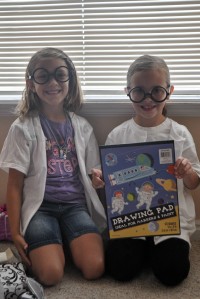
10:10-10:20 Presents (I always do presents at the end, but we did them right off this year because we had some friends who had to leave early. I took pictures of my daughter with each friend with the gift to use for thank-you cards. Yes, I make my children write thank-you’s. My picture quality is terrible.)
10:20-11:10 Science projects (Please note: We did not get to every activity, and some of the activities were really rushed. I would plan at least an extra 1/2 hour, if not more.)
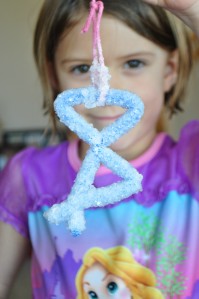
Borax crystals
1. Borax crystals: An activity they prepped and then got to take home to see the full effect.
2. Magic Milk: Pour a small amount of whole milk into a shallow dish. Put drops of food coloring all around the milk. Do not mix or blend. Dip the end of a toothpick in dish soap and gently touch the tip into the food coloring. It naturally swirls! Do it again and again until it starts to turn brown.

Rainbow in a jar. My top layer is falling… Ahhh…
3. Rainbow in a jar: Earlier this year, I did this experiment with my son’s 3rd Grade class for St. Patrick’s Day and taught a little lesson on density. My daughter thought it was so cool, she wanted her friends to see. This one I did myself and had the kids help pour the items in.
4. Homemade bouncy balls: This was one okay. Lots of fun and kind of messy. But it turned out to be more like silly putty than bouncy balls. The balls do bounce though, and the kids thought they were cool.
5. Tornado in a jar: Another one the kids watched. This one would be cool for them each to do.
6. Erupting sidewalk paint: So much fun! My kids love sidewalk paint. This time, you mix it a tad differently, let the kids decorate your driveway, then give them squirt bottles with vinegar, and their pictures bubble up. I would recommend mixing the paint with the kids or doing this one near the beginning, otherwise the cornstarch will settle and it won’t work.
7. Lava lamp: We did ours in disposable water bottles. I gave each kid a couple of Alka Seltzer tablets and let them break them in to smaller pieces and experiment. They then got to take these home.
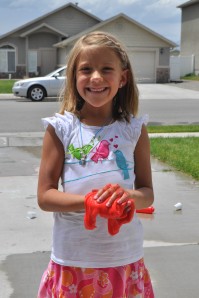
Flubber or Gak. I love the bright red!
8. Flubber or Gak: So fun! This makes a lot so you could cut the recipe down or have the kids share.
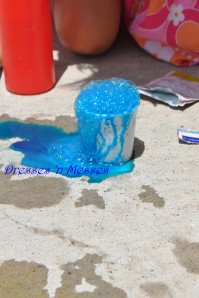
Vinegar eruption
9. Vinegar Rainbow eruptions: Probably my favorite experiment! We loved it so much we did it over and over after the party was over! Very messy! We put down paper towels for the party. Lots of paper towels. Afterwards, we did it on my driveway. It did stain the driveway, but it washed off in the rain.
11:10-11:20 Cake: She requested cupcakes. I didn’t do anything fancy, like test tubes or anything because she doesn’t know what those are. Just cupcakes.

Ice cream in a bag. The kids ate theirs from their bags, no bowls needed.
11:20-11:30 Ice cream in a bag
Take Home Favors: The fabulous thing about this party is that you don’t need too much extra. They took home their jelly beads, their flubber/gak, their crystals, their bouncy ball, their lava lamps, their ice cream in a bag, and their science gear. We also provided each child with a small container of Oobleck and a small bag of candy. I bought some cheap trays at the Dollar Store and labeled each with their names that they put their stuff in throughout the party. I bought gift boxes because it was 12 for a dollar, and that’s all I needed. They were floppy, but good enough for the car ride home. You could buy those disposable tin dinner trays, as well, which would be more sturdy. When parents came, they just had to pick up their tray with everything on it and go.
Honestly, this party was busy, high energy, and very interactive, but it was so much fun! I would do it again in a heartbeat.
For more birthday ideas, go here. I’m hoping to get some others we’ve done up soon!


 Dresses 'n Messes